Thom Jurek
Joe Pierre
Steve Lake
Brandt Reiter
Tom Sekowski
Unknown Author
Andrey Henkin
Reiner Kobe
Thom Jurek
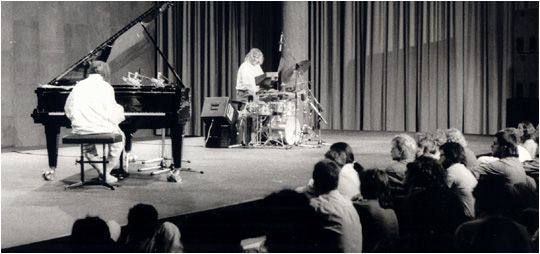
The duet between pianist Cecil Taylor and drummer Tony Oxley during Taylor's one-month stay in Berlin in 1988 is a study in contrasts. Musically, there is a similarity of approach between the two: Both are physical players with an ear for dark dramatics. Percussively, each attacks his instrument in the same way, palms down, forcing off the fingertips and into the instrument, whether drums or piano. Improvisationally, they differ greatly in that Taylor — so used to being a soloist — is proactive while Oxley is reactive; here, they attempt to bring both those roles into sync. Oxley moves his own attack up a notch, employing more elementals than just his kit, trying to "sing" the drums. For the entire hour, Taylor looks deeply toward a romantic sensibility he seldom shows, creating harmonic fixtures from accents and triples, while simultaneously constructing lyric melodies for Oxley to play from. And he does, weaving absolutely thrilling cymbal and bell lines through Taylor's arpeggios, turning his rhythms inside out to create the appearance of a harmonic register that engages all of the different figures Taylor is firing off like lit matches. There's no letup for the entire set; it's one dazzling display after another until the piece just implodes from exhaustion — physical, that is, as the ideas still come fast and furious — and leaves the listener dazed and awed by such a soulful yet pyrotechnic display. This is one of Cecil Taylor's most "melodic" improvisations ever.
from: All Music Guide
Joe Pierre
This is one of several live concerts between Cecil and a drummer, recorded during his residence in Berlin in the summer of 1988. This pairing between Cecil and Tony Oxley, which occurred on the last day of his stay, always, garners particular critical praise as a highpoint of the event, captured on FMP's excellently recorded 11-CD collection. It is deserving.
Tony Oxley has established himself as an intimate musical partner of Cecil, starting their relationship on this disc; then forming 'The Feel Trio' with William Parker (bass) in 1989 and recording "Celebrated Blazons," "Looking," and the monster 10-CD concert collection "Two T's for a Lovely T", and more recently touring heavily as a duo again over the past two years (2003-2004). Despite their frequent pairing, this is the only recording of them as a duo thus far on CD.
While Cecil is often described as a percussive player (playing "88 tuned drums"), Oxley's playing is impressionistic, largely devoid of syncopated rhythm, and rather melodic. As such, they achieve a sort of perfect harmony though there is of course hardly any melody to speak of. Oxley's drumming includes heavy use of wood blocks, what sounds like tiny little drums, and melodic tom-toms -- his playing is typically somewhat gentle (without a lot of crashing breakers on the cymbals unlike Günter Sommer on "In East Berlin" who seems to compete for spotlight and volume) and consistently a-rhythmic (unlike Han Bennink on "Spots, Circles, and Fantasy").
On the tunes here, Stylobate 1 features a lot of Cecil's signature thundering chords, while Leaf Palm Hand goes into more rapid-fire playing that melds with Oxley's. It's during this title track that it almost seems as though the cymbals and drums are suspended around Cecil and are sprung to life by the reverberations of the Bösendorfer rather than Oxley himself, such is their interplay. Chimes is more a quiet final movement in Leaf Palm Hand than a distinct piece, followed by two actual encores -- Stylobate 2, a brief but energetic romp full of powerful playing from both Cecil and Oxley, and The Old Canal with Oxley taking a very minor role and Cecil playing very spare, melodic phrases to conclude the concert. The Old Canal is incidentally something of an oddity, in that an encore with the same title is played on the "In East Berlin" disc -- and Cecil rarely has recorded a tune (or at least a tune with the same name) more than once.
There's no poetry or vocalisms in this concert, and William Parker's bass seems conspicuously absent since I have listened to so much of The Feel Trio's work prior to hearing this recording (if you like this concert, check out "Celebrated Blazons" or even "Nailed" with Evan Parker). And so, this is Taylor and Oxley together, without accompaniment that unlike some of the other Berlin duos is a study not of contrasts, but of harmony, inasmuch as that word is fitting for free jazz and the world of Cecil Taylor.
from: Amazon, October 22, 2004
Steve Lake
The old jazzcrit polemic bites the dust. No more American-versus-European or Black-versus-white rhetoric is admissible after this raging multinational celebration. One of the instigators of American "free jazz" hooks up with a succession of drummers (German, British, Dutch, Zulu) for a series of duets, encounters Derek Bailey, fields a trio with Evan Parker and Tristan Honsinger, and heads a 17 piece orchestra for a monumental performance. At the end of it all, Taylor's playing differently, and so are the Europeans. Everybody wins. Cecil Taylor In Berlin ‘88 swept all jazz polls in 1990. Rightly so.
from: The Wire # 100, June 1992
Brandt Reiter
If music criticism is difficult and jazz criticism is most difficult of all (how can any writer capture the essence of a form so elastic and alive?), well, what then is one to do with Cecil Taylor, the tireless 78-year-old avant garde piano eminence whose iconoclastic style remains so singular and uncompromising that it defies any attempts at definition, much less explanation? It’s enough to make any self-respecting critic retire permanently from the business.
What I can tell you is, structurally, Taylor’s music is essentially motific improvisation – that is, it’s based in the development of a motif, a repeated musical figure which quickly mutates into another motif, sometimes clearly related to the one previous, sometimes not, which quickly develops into another, then another, then another. And that’s about it. In between, a blizzard of notes that dance along the entire range of the piano, often breathtaking in speed, dynamics and imagination. When Taylor plays solo these motifs are, obviously, self-generated. When he plays in concert with a partner, such as longtime collaborator, the brilliant British drummer Tony Oxley, they’re passed back and forth between the two, Oxley responding to Taylor’s motif and simultaneously developing his own and Taylor responding in kind. The result is music that seems both relentlessly new and oddly continuous; often Oxley, whose ability to find figural and tonal variation on his kit is awe-inspiring, will carry over Taylor’s previous motif as the pianist moves into the next, with Taylor doing the same as the drummer, for a fractional second, takes the lead. It’s fascinating, maddening and exhilarating all at once.
And there, in a deeply insufficient nutshell, is Leaf Palm Hand, the reissue of a splendidly recorded 1988 gig consisting of five pieces that range from under 3 minutes (the melancholic closer “The Old Canal”) to 42-plus (the whirlwind title cut). For those readers who know Taylor’s work and love or hate him (both are legion and few, if any, fall in the middle), you now know all you need to know. For neophytes, any further explication requires listening, though even the word “listening” seems not quite right. At the first set of the duo’s final night at the Village Vanguard Nov. 9th, I found it most effective simply to shut my eyes and let the music produce bursts of light and color in my head, while occasionally mumbling to myself, “How are they doing that?”, before stumbling, overwhelmed and disoriented, into the newly wondrous West Village night.
from: All About Jazz – New York, January 2009
Tom Sekowski
As part of his residence in Berlin in 1988 [which resulted in the Live in Berlin '88 box set on the FMP imprint], Cecil Taylor played a number of duets with percussionists. Günter Sommer, Paul Lovens, Louis Moholo, Han Bennink were amongst those. The fifth CD in order of appearance in the box set was one Taylor shared with Tony Oxley. "Leaf Palm Hand" saw a logical progression in Taylor's choice for his dream percussionist. Staying within the realms of Europe [the workshops involved European musicians], Oxley fits the mould perfectly. As the two feel each other out, Taylor proposes a few key strokes at a time, while Oxley responds with cymbal heavy crashes. Taylor's dance-like tickles on the ivories turn into full blown gale-force attack early on. Throughout the course of two lengthy numbers [totaling just over an hour], the duo establish a rapport. It's not just a rapport of two individuals who've not played before, but a common language that is established. While Taylor has certain expectations of his percussionist counterparts, he never makes that apparent while performing. He expects his partner to be able to read his musical direction while the music is being produced live. The give-and-take coherence these two launch is stated on a nearly telepathic level. A couple of brief piano pieces at the tail end of the record encapsulate the atmosphere. Nothing is left to chance and the two make it sound as if that particular night in Berlin twenty years ago they had a blast. Taylor would go on to bring Oxley into his Feel Trio, which had its beginnings shortly after the proceedings in Berlin wrapped up. Only special relationships are born out of coherent musicianship and perfectly matched skills. Flawless!
from: Gaz-Eta # 68, 2008
Unknown Author
One of the most powerful Cecil Taylor albums for FMP -- a great set of duets with drummer Tony Oxley, and one that really brought Oxley's talents to the attention of a whole new generation! Cecil's piano is boldly expressive throughout, but always has its own sense of core -- that Taylor-like magic that really seemed to click into place during the 80s, with almost its own intrinsic sense of rhythm and logic -- even when things are quite outside. Oxley turns out to be a great partner for that sort of sound -- opening up his drums with almost melodic like qualities -- hitting the kit with the same sort of free energy that Taylor brings to the keyboard of the piano -- really setting fire at points, but making things soft and contemplative at others. Wonderful work throughout -- with titles that include "Stylobate 1", "Chimes", "The Old Canal", "Stylobate 2", and "Leaf Palm Hand".
from: Dusty Groove America, Inc., 2008
Andrey Henkin
In the summer of 1988, pianist Cecil Taylor (then just shy of 60) played a number of significant concerts over a month’s time at the Kongresshalle Berlin collected as CecilTaylor in Berlin ‘88. There are solos, a piano-cello-saxophone trio, a pairing with guitarist Derek Bailey and several duets with drummers like Han Bennink, Louis Moholo, Paul Lovens, Günter Sommer and this final concert with Englishman Tony Oxley. The album (available separately) is 70 minutes of Taylor at his best.
from: The New York City Jazz Record, July 2013
Reiner Kobe
Die 12-CD-Box „Cecil Taylor in Berlin ’88“ ist längst vergriffen, so dass man aufmerksam registriert, wenn Wiederveröffentlichungen des legendären Workshops auf den Markt gelangen. Dies ist jetzt mit dem Duo von Cecil Taylor und Tony Oxley geschehen, das sich damals zusammenfand und bis heute Bestand hat. Beide Musiker kommen aus unterschiedlichen kulturellen Traditionen. Während Taylor aus traditioneller schwarzer, indianischer und auch asiatischer Kultur schöpft, ist Oxley der europäischen verpflichtet. Beide befruchten sich gegenseitig, dicht ist ihr Zusammenspiel. Die perkussiv geprägte Spielweise Taylors entspricht der klanglich orientierten Perkussion Oxleys. Und wie der Afroamerikaner konventionelle Klaviermuster zerstört, durchbricht der Brite die Gleichförmigkeit rhythmischer Muster. In diesem Duo haben sich zwei seelenverwandte gefunden. Bestechend sind virtuose Artikulationsfähigkeit und Präzision auf engstem Klangraum, wie sie in Duo-Einspielungen Taylors immer wieder sichtbar wurden.
aus: Jazz Podium # 4, April 2008
see: Reviews Cecil Taylor in Berlin ‘88
siehe: Kritiken Cecil Taylor in Berlin ‘88
 |
|
| Cecil Taylor & Tony Oxley | Photo: Dagmar Gebers (1988) |
©
The copyrights remain with the aforesaid sources and/or with the authors.
Die Copyrights liegen jeweils bei den genannten Quellen und/oder bei den Autoren.